


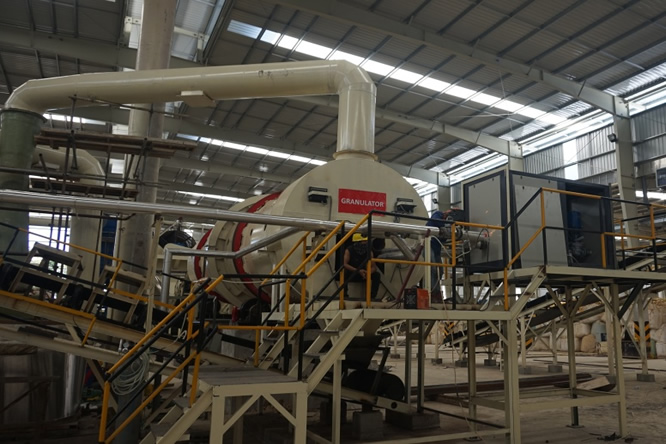
Before the implementation of the livestock and poultry manure treatment project, procurement personnel often make the mistake of treating organic fertilizer equipment and bio organic fertilizer equipment as one thing. There are significant differences between the two in terms of fermentation process, granulation method, and post-treatment configuration. Choosing the wrong one directly affects the maturation effect and product qualification rate. The core task of bio organic fertilizer equipment is to retain the activity of functional bacteria on the basis of aerobic fermentation, which determines that it has stricter requirements for temperature, moisture, and granulation methods than ordinary organic fertilizer equipment.
The four common materials have completely different equipment configuration logic
Pig manure has a high moisture content and high viscosity, making it easy to clog when directly fed into the granulator. Hongxin Environmental Protection Technology usually uses trough type or wheel type turners in pig manure treatment solutions, compressing the composting cycle to 7 to 10 days and achieving a composting rate of around, before entering the semi wet material crushing stage. Chicken manure has a high organic matter content but also a high nitrogen content. Fermentation heats up quickly, and the frequency of turning piles is higher than that of pig manure, otherwise it is prone to hypoxia and odor. The heavy metals and moisture content of sludge materials fluctuate greatly, requiring stronger crushing and mixing capabilities for pre-treatment, and leaving a regulating agent addition port in the batching process. The cow dung fiber is coarse and has high humidity, and the ball forming rate of ordinary disc granulators cannot be improved. The new type of stirring tooth granulator is designed for such high humidity materials, and the qualified granulation rate can achieve the above.
By comparison, ordinary organic fertilizer production lines place more emphasis on production capacity and particle strength, while bio organic fertilizer equipment needs to control temperature rise in the granulation process to avoid high temperature killing functional bacteria. There are two process routes: low-temperature drying and non drying granulation. The former is suitable for materials with high moisture content, while the latter is suitable for production lines with well done front-end dehydration. The thermal energy utilization rate of the dryer is above 85%, and the energy consumption is about 15% lower than the industry standard. The difference in this account is very obvious after long-term operation.
How to match a complete production line, divided by scale
Organic fertilizer production lines with an annual output of 10000 to 300000 tons can be customized, with differences mainly in the specifications of fermentation turning equipment, granulator models, and the degree of automation of packaging scales. The 5000 ton annual small-scale pig manure production line is flexible in configuration, with an investment return period of 18 to 24 months, suitable for individual farmers and small cooperatives to start farming. The medium-sized standardized equipment package is easy to operate and has strong adaptability. Agricultural cooperatives purchasing together can dilute the cost of individual machines. Large scale breeding groups are more suitable for the entire production line of manure treatment with EPC general contracting, from process design to installation and commissioning in one go, and the environmental impact assessment link is also better connected.
The production line of compound fertilizer and blended fertilizer is another technical route. The urine based and amino acid granulation production line can achieve full process PLC automation control, reduce labor costs, achieve level II measurement accuracy, and ensure product stability and consistency.
Three details that are easily overlooked when selecting
The flipping depth and span of the fermentation flipping equipment should match the site conditions. The trough type is suitable for fixed operations in the factory, while the wheel type is suitable for open-air or semi open-air storage yards. Choosing the wrong one will result in high renovation costs in the later stage.
The granulation method should be aligned with the material characteristics. Roller extrusion granulation is suitable for powdery materials with low moisture content, disc granulation is suitable for materials with medium and low humidity, stirring teeth granulation is more friendly to high humidity and high viscosity materials, and the combination of drum and stirring teeth can meet both working conditions.
The screening and packaging accuracy in the post-processing stage directly affect the appearance of the finished product. The grading efficiency of the drum screening machine and the measurement error of the fully automatic packaging scale must be clearly verified during procurement negotiations, and cannot be adjusted until production begins.
How to control operation and maintenance costs
The annual maintenance cost of bio organic fertilizer equipment usually accounts for 3% to 5% of the total equipment price, with core expenditures on gearbox, bearing, and sensor replacement. The body is designed with corrosion-resistant reinforcement, and the core components are controlled by a reducer and PLC, which can reduce the failure rate to a certain extent. It is possible to save 120000 to 180000 yuan in operating costs for a production line with an annual output of 100000 tons, mainly through energy consumption optimization and labor reduction.
The after-sales response speed should also be clarified in advance. The motor reducer has a one-year warranty, with on-site visits within 24 hours within the province and 48 hours outside the province. The supply cycle of accessories is controlled within 72 hours. These terms written into the contract are more reliable than verbal promises.
The core logic for selecting equipment for bio organic fertilizers is to first understand the characteristics of ones own materials, site conditions, and production capacity goals, and then reverse engineer how to match the three stages of fermentation, granulation, and post-treatment equipment. Once the materials are matched, the operation and cost can be controlled later.
