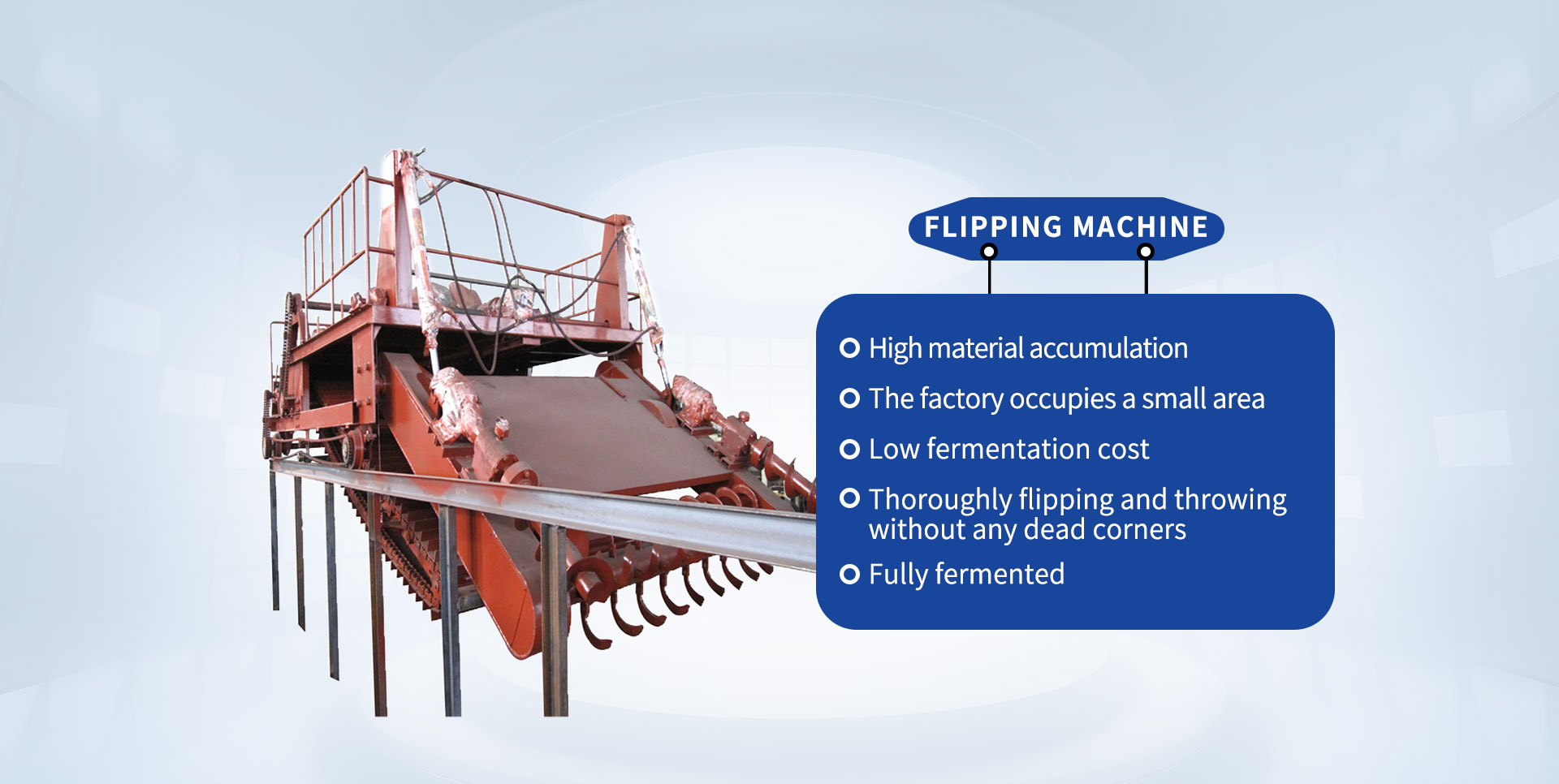


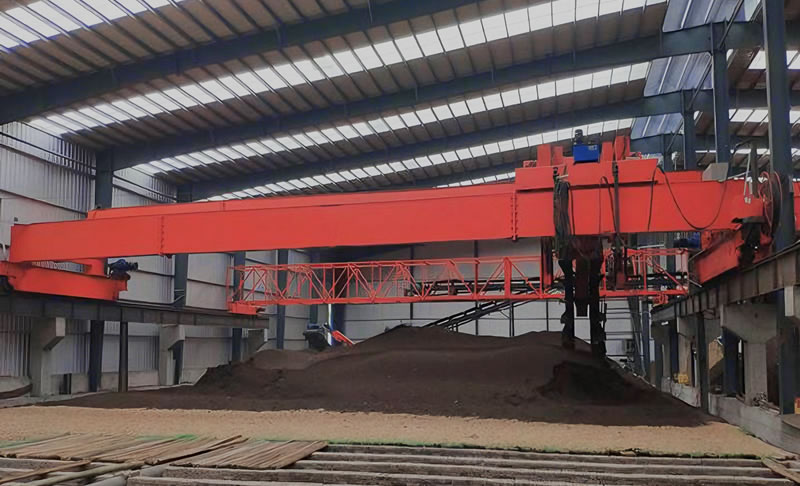
The self-propelled composter adopts a four-wheel walking design, allowing it to move forward, reverse, and turn, and can be controlled and driven by one person. During operation, the entire vehicle rides on the pre-stacked long strip-shaped fertilizer base, and the rotating blade shaft mounted under the frame implements the turning, mixing, fluffing, and stacking of the fertilizer base material. After passing through, it forms a new strip-shaped pile.
Product performance and working principle of self-propelled compost turner
The self-propelled composter is designed with four wheels for self-propulsion, operated by one person, and equipped with anti-slip tires. When in motion, the entire vehicle rides on top of the strip-shaped pile, forming a new strip-shaped pile behind it. This machine is suitable for operation in various fields. It also features a crushing function during the later stages of material fermentation. The overall structure is rigid and the performance is safe and stable.
Working principle: The diesel engine is used as the power source, transmitting motion through the power transmission system. A machete is employed to rotate and turn the material. The operation of the turning machine is controlled by a driver.
1. The work site needs to be flat and solid, and there must be no uneven surfaces larger than 50mm within the operation area.
2. Strip stacking: The width should not be too wide, and the height can be appropriately increased within 100mm, with no limitation on length.
3. A space of no less than 10 meters should be left at both ends of the material pile for turning, and the spacing between material piles should be more than 1 meter.
4. This machine is only a walking-type turning machinery and cannot be used as a walking vehicle or heavy-duty vehicle.
Characteristics of self-propelled compost turner equipment
Compared with other types such as "overturning machines", "mixers", and "spiral agitators", self-propelled compost turners have distinct features:
The fermentation process adopts microbial oxygen-consuming fermentation, designed based on the principle of oxygen-consuming fermentation, providing the fermenting bacteria with sufficient space to fully exert their functions.
2. It is more suitable for the mechanism and process requirements of microbial fermentation of livestock manure into fertilizer, effectively mixing viscous livestock manure with microbial agents and straw powder. This creates a better aerobic environment for material fermentation. For cow manure in this loose material state, the fermentation temperature can be controlled at 60-70 degrees for 3-4 days. 3. The whole machine has balanced and suitable power, low energy consumption, and high output, reducing the production cost of bio-organic fertilizer. According to the technical parameters of the machine, a small machine can mix 400-500 cubic meters of fresh cow manure per hour (equivalent to the tireless workload of 100 people working simultaneously). The whole factory only requires 4-5 workers, making the finished fertilizer have a significant price advantage.
4. The overall structure of the machine is reasonable, with good rigidity, balanced force distribution, simplicity, robustness, stable performance, easy operation, and strong adaptability to different sites. Apart from the sturdy frame, all components are standard parts, making it convenient for use and maintenance.
