


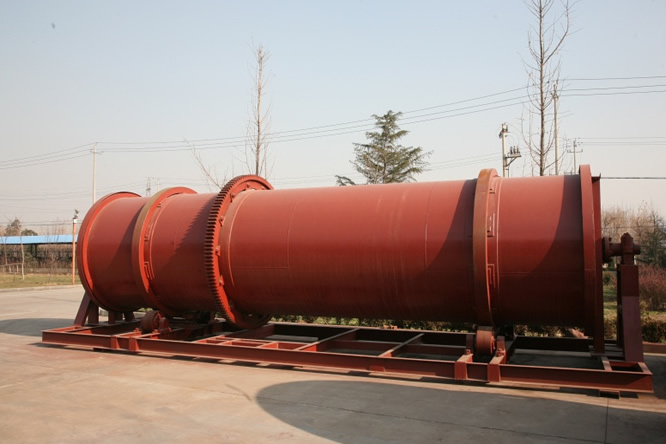
The compound fertilizer granulator equipment features room-temperature production with bacterial preservation, rational structural design, and the ability to produce spherical granular products. The resulting granules exhibit low moisture content, easy drying, high molding efficiency, excellent strength, and an aesthetically pleasing appearance, making it an ideal granulation device for bio-organic fertilizers, organic-inorganic fertilizers, and organic-inorganic compound fertilizers.
Product Structure: The machine is composed of components such as the frame, roller, internal mixing teeth granulation mechanism, internal transmission mechanism, and external transmission mechanism.
The rack is welded from thickened channel steel.
2. The drum is welded from thickened steel plates and adopts the form of a rotary drum granulator.
3. The granulating mechanism adopts the stirring tooth granulation method.
4. The external drive uses cast steel gears for power transmission. **Compound Fertilizer Pelletizing Machine** **Product Introduction:** The compound fertilizer pelletizing machine is designed and manufactured using a new wet-process continuous push-rod pelletizing technology. It utilizes high-speed rotary mechanical stirring force and the resulting friction to continuously mix, granulate, spheroidize, densify, and polish fine powdered materials within the machine, achieving the goal of pellet production. This machine combines the advantages and features of both rotary and push-rod pelletizing technologies. It is capable of pelletizing various organic materials as well as producing compound fertilizer pellets. Additionally, it can pelletize coarse fibrous materials—such as crop straw, distillers grains, furfural residue, microbial residues, pharmaceutical residues, and animal manure—after fermentation. It also achieves excellent pelletization results with raw materials like humic acid and urban sludge.
Product Advantages of Compound Fertilizer Granulator:
1. Adopt a new pelletizing process integrating multiple functions such as rotation, spheroidization, polishing, densification, heating, and drying.
2. Utilizing high-strength alloy materials ensures durability and extends equipment lifespan (with virtually no wear-prone components).
3. The material moisture content can be pelletized within the range of 30% to 40%, with an outlet moisture level around 30%. This reduces the conventional drying requirement of 70% moisture, effectively lowering the production cost of organic fertilizers.
4. During the granulation process, a temperature of 50 to 65 degrees is generated inside the barrel, reducing the moisture content of the discharged pellets by 5 to 8 points, thereby lowering the drying cost requirements.
5. The pellets are uniform, smooth, round, and have high strength, with a pellet formation rate exceeding 95%.
6. By adjusting the moisture content of the feed, the size of the discharged particles can be controlled, thereby meeting different particle size requirements.
7. The feed material can be granulated with a fineness of around 20 mesh, improving the traditional granulation process requirement of at least 80 mesh or higher.
Common Faults and Troubleshooting Methods for Compound Fertilizer Granulators:
Unable to granulate or granulate unevenly
The material fineness is insufficient; use appropriately crushed and sieved raw materials of the suitable fineness for production
2. The materials adhesion is insufficient; add a binder
3. Improper material ratio, adjust the proportions between various raw materials
4. The material moisture is too low; increase the spray water and mix thoroughly.
5. Uneven feeding; distribute the feed uniformly
